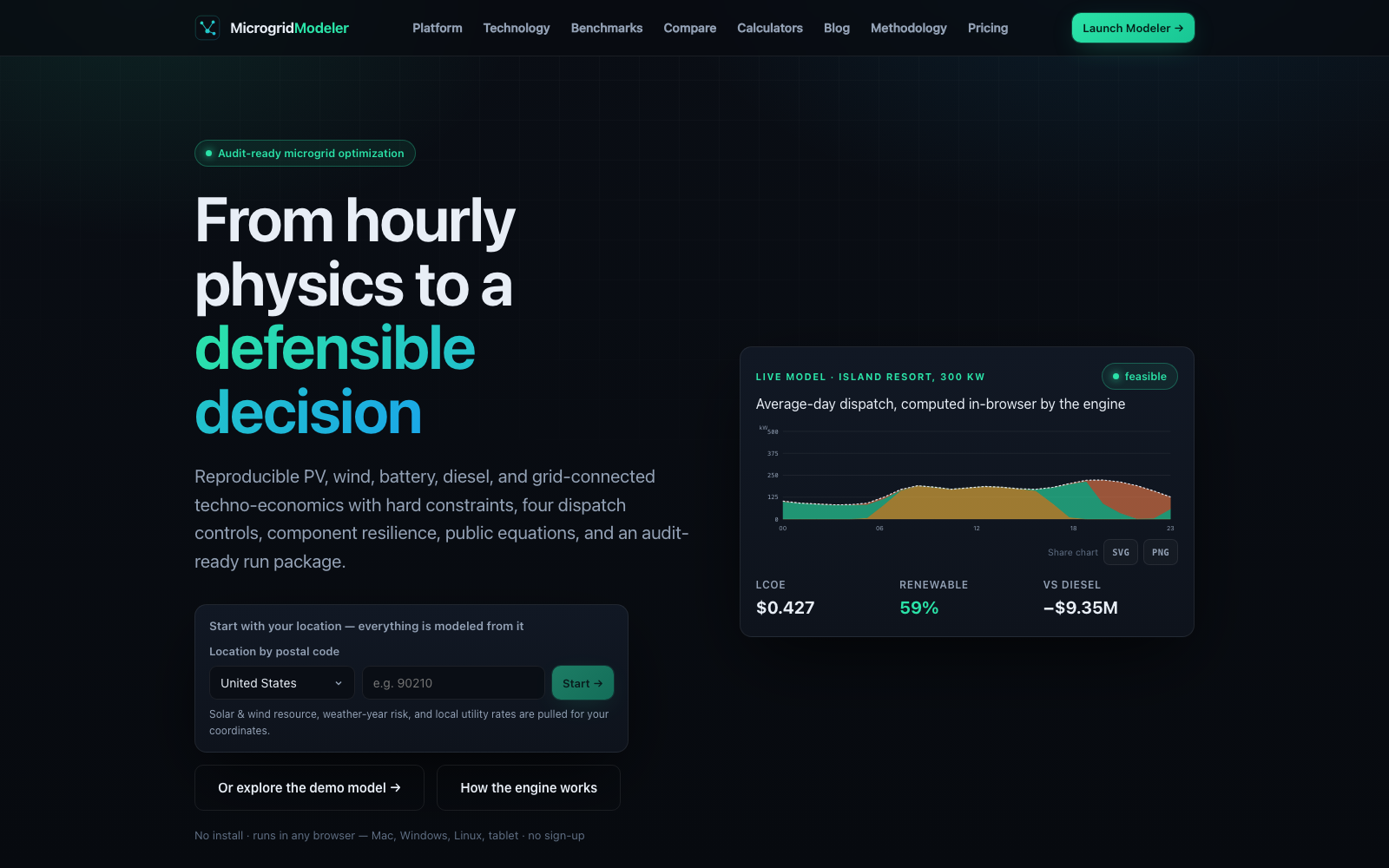
MicrogridModeler Launches Browser-Based Solar and Storage Design
A new microgrid modeling platform has arrived, and it tackles one of distributed energy’s most persistent problems: turning a promising solar-and-storage concept into a decision another person can actually inspect.
MicrogridModeler.com has launched as a browser-based workspace for comparing solar PV, wind, battery storage, diesel generation and grid-connected microgrids. It combines chronological hourly dispatch, lifecycle economics, sizing search, outage analysis and exportable evidence in one unusually accessible interface. There is no software installation or account wall; the model runs in a current browser.
That combination is genuinely impressive. Plenty of tools can produce an answer. MicrogridModeler is designed to show the assumptions, constraints and hourly behavior behind the answer—exactly where battery-storage proposals often become difficult to review.
Storage sizing is an hourly problem
A battery’s nameplate energy capacity says little by itself. The useful answer depends on power limits, state of charge, round-trip losses, the timing of renewable generation, the timing of load, dispatch priorities and what happens during a poor-resource period. A spreadsheet based on monthly energy totals can make a system appear balanced while hiding hours when it is short of power.
MicrogridModeler works chronologically across 8,760 hourly intervals. It tracks how generation serves load, how surplus charges storage, when storage discharges, when a generator starts, what the grid imports or exports, and when energy is curtailed. That makes it useful for the questions Energy Storage Media readers ask every day: Is the battery cycling for bill savings or resilience? Is PV being overbuilt only to be dumped? Is a diesel set carrying a few expensive evening hours? Does the proposed design actually meet its declared reliability constraint?
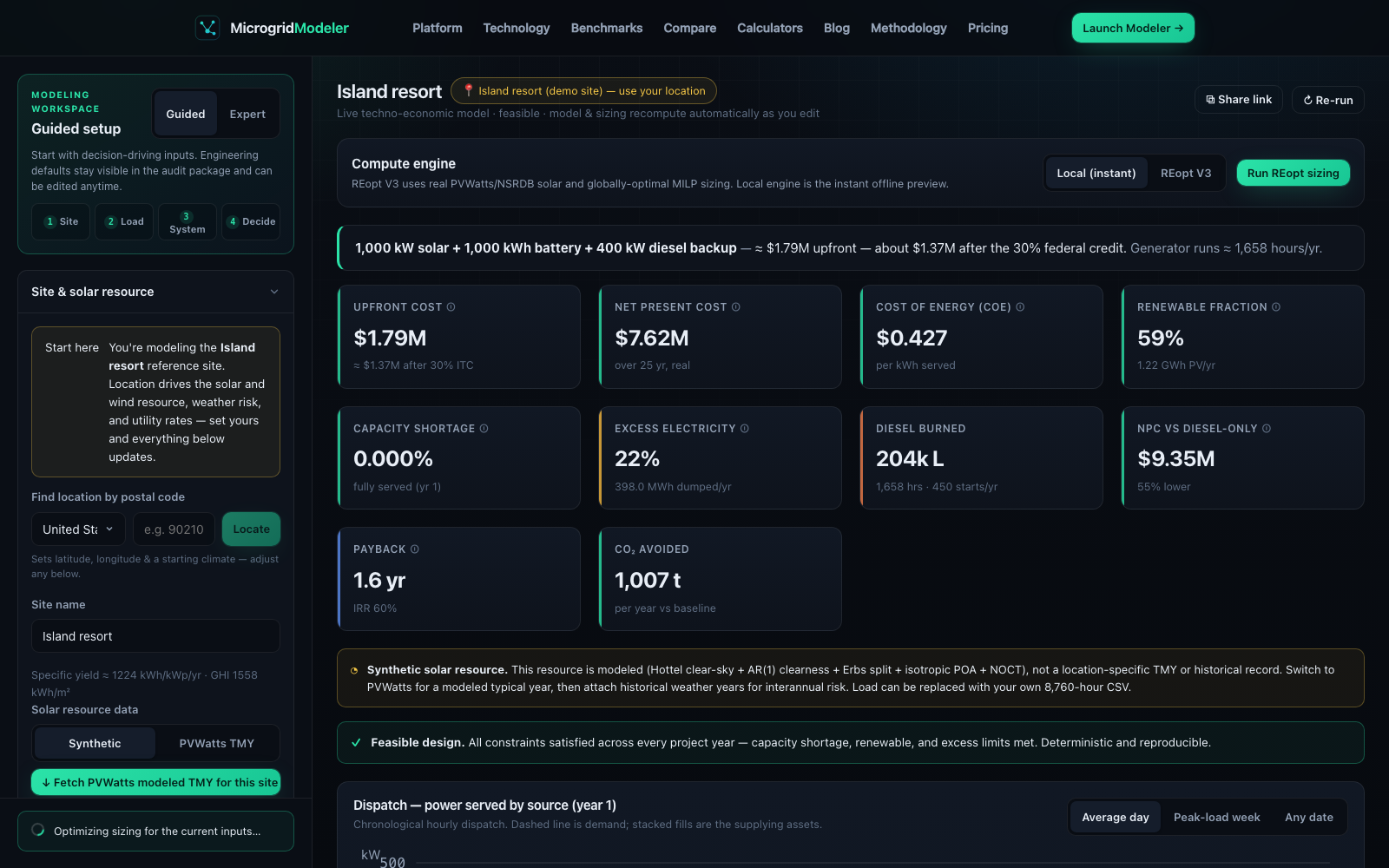
What MicrogridModeler puts in one workspace
The platform supports fixed or tracking PV, wind, asymmetric battery charging and discharging, generator fleets, startup delay and optional utility tariffs. Users can start from a reference project, enter a location, import an hourly load file, use an appliance-based load builder or begin with a utility bill. Solar inputs can move from clearly labeled synthetic data to modeled or historical resource data.
Its sizing workflow evaluates a declared PV × battery × generator search space, rejects candidates that violate supported constraints and applies deterministic refinement around promising designs. The claim is deliberately bounded: it identifies the lowest-net-present-cost feasible point among the candidates it evaluates. That is much more useful than calling every result a mysterious “global optimum.”
The results include upfront cost, net present cost, cost of energy, renewable fraction, fuel consumption, capacity shortage, excess electricity, payback, emissions and comparison with a consistently dispatched baseline. Four selectable dispatch controls let users see that hardware sizing and operating policy are linked decisions rather than separate exercises.
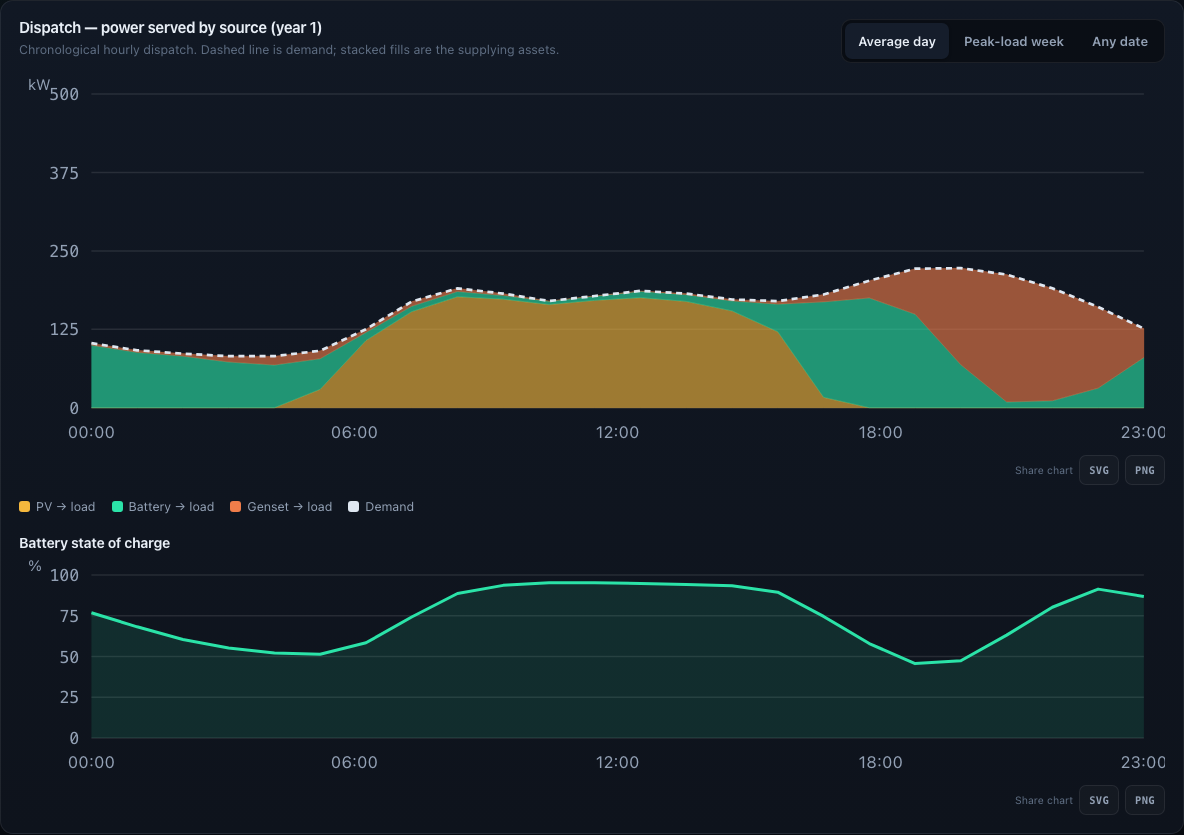
Why the launch matters for battery developers
First, constraints are treated as decisions, not footnotes. Users can specify limits for unmet load, renewable share, excess electricity and operating reserve. A design that misses a supported hard limit is marked infeasible before cost ranking.
Second, uncertainty is visible. The platform can test historical weather years and display resource-risk screens instead of presenting one “typical” year as destiny. Sensitivity tools let a reviewer move fuel price and other assumptions and watch the economics respond.
Third, resilience goes beyond adding backup capacity. MicrogridModeler starts outages at different hours from the battery state of charge created by normal dispatch, then tests how long the critical load survives. Its component-disturbance analysis can degrade PV, wind, battery strings and generator units, apply repair behavior and report seeded, reproducible resilience measures.
Fourth, the handoff is stronger. A run package can carry inputs, provenance, outputs, hourly results, constraints and an input fingerprint. That does not turn a screening model into construction engineering, but it gives the next reviewer something far better than a screenshot of a single cost number.
From first location to a defensible case
The fastest way to explore the release is to open the modeler, set a real project location and choose a load basis. Location comes first because it drives solar and wind resource, weather-year exposure, seasonal load context and available rate data. From there, select allowed assets, set the reliability and renewable constraints, then compare dispatch and economics.
Do not stop at the headline design. Inspect the hourly chart, generator runtime, curtailed energy, battery behavior and poor-weather performance. Run an outage case. Sweep a volatile assumption. Then export the evidence. This is where the platform moves from a slick calculator to a useful decision workflow.
Important engineering boundaries
MicrogridModeler is a single-bus energy-balance and techno-economic screening platform. It does not establish feeder voltage, conductor ampacity, fault duty, protection coordination, harmonics, dynamic stability, controls performance, permitting or constructability. Those remain tasks for qualified engineers and project teams.
Input quality matters just as much. The reference projects and synthetic resources are excellent for learning, but a capital decision should graduate to measured or defensible hourly load, site-specific resource data, current tariffs, vendor quotations and explicit engineering assumptions. The platform helps make those provenance differences visible; it cannot manufacture certainty that the inputs do not contain.
That candor is part of what makes the launch exciting. The product draws a bright line between what its model can prove and where detailed engineering must begin.
MicrogridModeler launch FAQ
What does MicrogridModeler model?
It performs hourly techno-economic and resilience analysis for combinations of solar PV, wind, battery storage, diesel generation and the utility grid.
Does it replace electrical engineering studies?
No. It is a single-bus energy-balance and investment-screening tool, not a feeder power-flow, protection, short-circuit, controls or construction-design package.
Can I use site-specific data?
Yes. Users can locate a project, use modeled or historical solar resources, enter utility rates and import their own 8,760-hour load or weather series.
What should battery developers inspect first?
Check hourly state-of-charge behavior, charge and discharge power, curtailed energy, generator runtime, unmet-load constraints and resilience from realistic outage start times—not only annual cost.